
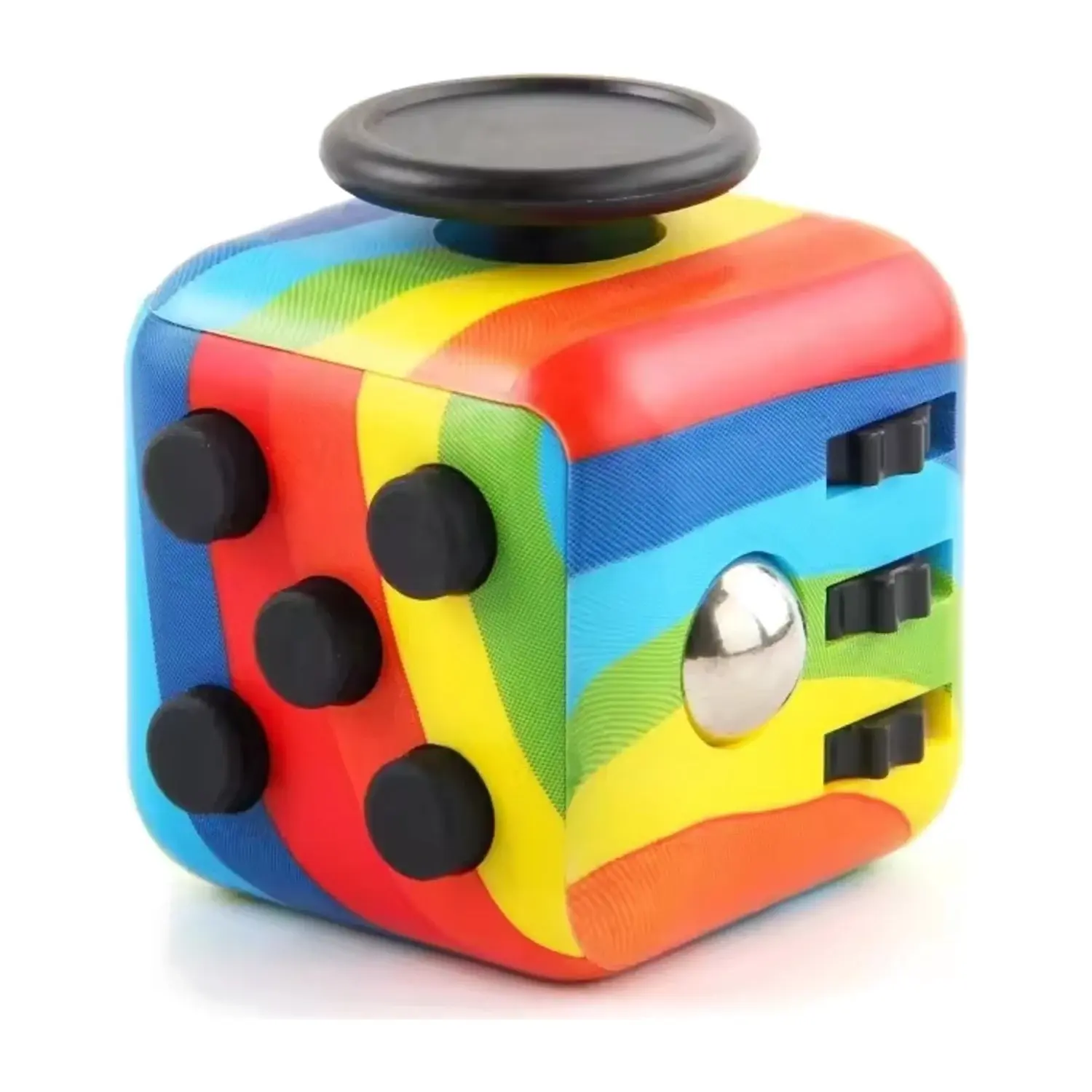

Fidget cube: a small movement, a moment of calm
Some children find it hard to sit without their hands doing something. The fidget cube gives the hands a small, defined activity, freeing the mind to listen, think or wait.
Each of the cube's six sides has a different action: pressing, spinning, rolling, sliding, clicking and stroking. The child can choose the sensation that suits them at that moment and move from side to side.
What's on the six sides?
Buttons: buttons to press, some clicky and some quiet.
Joystick: a small controller that moves in every direction.
Switch: an on/off switch. Flipped quickly it makes a click, and flipped slowly it's almost silent.
Rolling: gears that turn, and a small metal ball you can roll and press.
Spinning: a round spinning disc with a finger groove.
Breathing: a smooth groove to rest your thumb in, for calm, quiet stroking.
Who is it for?
Children aged 3 and up.
Children with sensory regulation difficulties.
Children on the autism spectrum.
Children with ADHD or attention difficulties.
Any child or adult who enjoys keeping their hands busy while working, traveling or waiting.
Where does it help?
At home: during homework, reading, watching or conversation.
In a therapy room: as a regulation tool at the start or end of a session, or during conversation.
Traveling and waiting: in line at the doctor's, in the car, at a restaurant.
In class: possible, but with care. Some sides make clicks that may disturb other children. In class it's best to choose the quiet sides, like breathing, the joystick and rolling, and to coordinate use with the teacher.
What does the research say?In a study of four children with ADHD, using a quiet hand fidget improved attention during class. When the tool was taken away, attention dropped, and when it was returned, attention rose again. It's a small study, so there's no guarantee every child will respond this way. But it does show that a fidget tool can help, especially when the child uses it as a tool rather than a toy.Mathews, Osmani & Martin, 2020, NASET / JAASEP
A tip from Maagali Introduce the cube to your child as a tool that helps them listen, not as a toy. You can agree on simple rules together, for example: "The cube stays in your hands, and during homework we only use the quiet sides." Many children discover on their own which side calms them the most.
Specifications
Size: 3×3×3 cm. The cube fits easily in the palm, a pocket or a pencil case.
Cube body: hard ABS plastic, resistant to drops and wear.
Mechanisms: plastic, flexible silicone and small metal parts, such as the steel ball and internal springs.
Colors: white, or multicolored rainbow pattern.
Age: 3 and up.
Safety
The product contains small parts and is therefore a choking hazard. It is not suitable for children under 3. Check from time to time that all parts are firmly attached, and stop using the cube if any part has come loose.
At Maagali, we believe a small accessory can sometimes make a big difference when used correctly. The product is only part of the solution, and alongside it we're here with knowledge, guidance and a place to ask for advice.

